The racket string tension tester is a high-precision performance testing device specifically designed for tennis rackets, badminton rackets, squash rackets, etc. By simulating stringing, ball hitting ...
The racket string tension tester is a high-precision performance testing device specifically designed for tennis rackets, badminton rackets, squash rackets, etc. By simulating stringing, ball hitting and environmental changes, it comprehensively verifies the tension retention rate, fatigue resistance life, node strength and dynamic response performance of the strings. This equipment is widely used in racket manufacturers, stringing service institutions and quality inspection laboratories to ensure that products meet international standards such as ITF, ASTM F2717 and ISO 9001, providing scientific guarantees for the durability and competitive performance of racket string beds.
Product Overview
The racket net string tension tester (RA machine) is suitable for testing the tension of racket net strings. It comes with a pair of positioning rods for badminton rackets and a pair for tennis rackets. There is an auxiliary positioning rod and a counterweight for tennis racket frames. There is one counterweight for badminton rackets and one for tennis rackets. The positioning arm has two scale slots.
Relevant parameters
| Item | Parameter Range |
|---|---|
| Force Display | Mitutoyo digital indicator (Japan) |
| Accuracy | 0.01 mm |
| Swing Arm Length | 250 mm |
| Clamping Length | 100~120 mm |
| Dial Angle | 0~90° |
| Power Supply | AC 220 V, 5 A |
| Dimensions | 900×350×400 mm (LWH) |
| Tension Range | 10~200 lbs (expandable to 300 lbs) |
| Tension Accuracy | ±0.5% FS |
| Impact Frequency | 10~100 times/min (accuracy ±1 time) |
| Test Wire Diameter | 0.6~1.5 mm |
| Data Sampling Frequency | 1000 Hz (dynamic parameters) / 100 Hz (full parameters) |
Core Functions
Multi-mode Tension Testing
Static Tension Decay Test: Tension range 10 to 200 pounds (pounds can be switched to Newtons), accuracy ±0.5% FS, monitoring tension loss rate within 24 hours/7 days/30 days after stringing (≤5% is excellent).
Dynamic Fatigue Test: Simulating ball impact (frequency 10 to 100 times/minute), detecting tension decay (accuracy ±1 pound) and node slippage risk under cyclic loading.
Environmental Coupling Test (Optional)
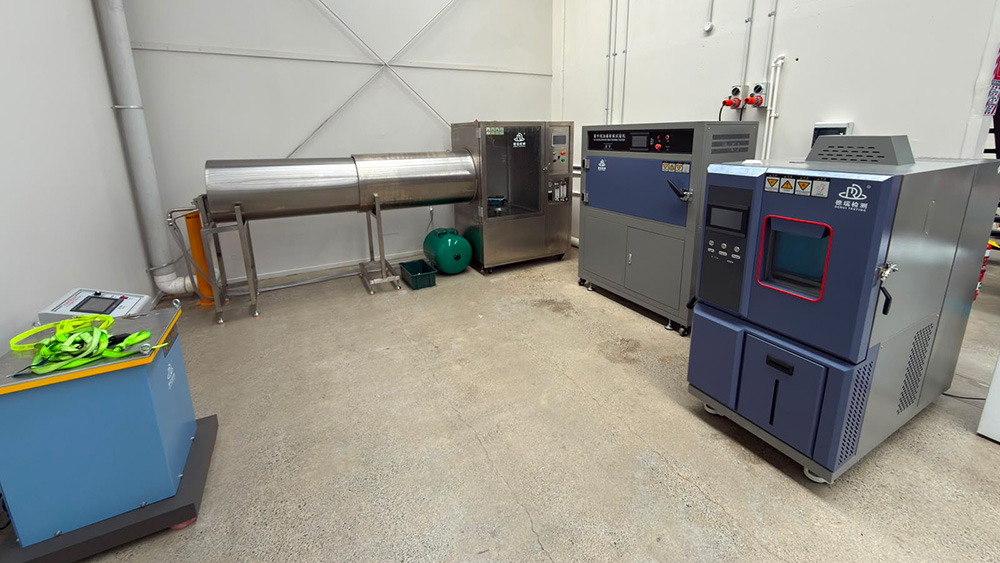
Temperature and Humidity Cycling: Temperature range -10°C to +50°C, humidity 30% to 90% RH, verifying the thermal expansion and contraction and aging characteristics of nylon, polyester and other strings.
Ultraviolet Aging: UV-A/B band irradiation (0.5W/m²), evaluating the anti-ultraviolet embrittlement performance of strings (such as gut and synthetic gut).
Intelligent Monitoring and Diagnosis
Real-time multi-parameter collection:
1. Tension (±0.5% FS), racquet frame deformation (laser distance measurement ±0.01mm), vibration spectrum (5 to 2000Hz), temperature (±1°C).
2. High-speed camera (1000fps) captures micro-cracks and node breakage processes of strings.
AI Failure Warning: Machine learning algorithm analyzes tension fluctuations and spectral anomalies to predict the risk of string breakage or loosening, automatically stops the machine and generates maintenance suggestions.
Data Traceability: One-click export of PDF/Excel reports (including tension-time curves, decay rate statistics), supporting MES system integration and batch traceability.
Technical Highlights
High-precision Tension Control
1. Closed-loop control with servo motor and high-precision torque sensor, tension resolution ±0.1 pound, dynamic response ≤ 10ms.
2. Modular fixture design, suitable for different racket types (tennis rackets/badminton rackets/squash rackets) and string hole layouts (16×19, 18×20, etc.).
Bionic Ball Hitting Simulation: Pneumatic impact head (adjustable force 20~100N), simulating real hitting angles (0~45°) and ball speeds (30~200km/h).
Safety Protection: Fully enclosed protective cover (preventing string splashing), emergency stop, overload protection, meeting ISO 13849 (PLc level) safety standards.
Equipment Advantages
High Efficiency and Precision: A single test cycle is ≤ 5 minutes, with data repeatability error < ±0.5%. Supports dual-station expansion (efficiency increase of 200%).
Comprehensive Coverage
1. Compatible with wire diameters of 0.6 to 1.5mm (tennis strings/racket strings), tension range of 10 to 200 pounds (expandable to 300 pounds).
2. Optional wire material friction coefficient test module (assessing wire smoothness).
Cost Optimization
1. Laboratory testing replaces athlete testing, reducing R&D costs by 60% and shortening the new product launch cycle.
2. Early defect interception reduces customer complaints and string breakage risks in professional events.
Standard Compliance: Built-in 20+ test procedures including ITF, ASTM, ISO, etc., generating global certification reports with one click.
Application scenarios and industry value
Production quality inspection: Tension retention rate test before wire release to screen out uneven stretching or coating defects.
Wiring service: Verify the accuracy of the wiring machine (e.g., ±1 pound error), optimize the wiring process (pre-tensioning/double knot/professional wiring method).
Research and development innovation:
1. Comparative analysis of fatigue resistance and resilience of new types of wires (such as polyester and aramid fibers).
2. Optimization of node strength (such as ultrasonic welding and hot melt adhesive curing processes).
Certification testing: Compulsory items such as ITF professional tournament wire certification and ASTM bed durability.
The racket string tension testing machine, through high-precision tension control and intelligent analysis, upgrades the performance test of the string bed from "empirical judgment" to "data-driven", helping enterprises overcome the core challenges of string life and competitive performance. Whether it is to meet the extreme tension requirements of professional events or to optimize the durability of amateur rackets, this equipment can serve as a core tool for research and development and production, safeguarding brand professionalism and user trust.