Technical parametersParameterSpecificationRoller Speed Range1–50 km/hSprocket Torque400 N·mRotation Speed (Chain-Driven Servo Motor)320 rpm (with 673 mm outer diameter wheel set, max speed: 40 km/h)To ...
Technical parameters
| Parameter | Specification |
|---|---|
| Roller Speed Range | 1–50 km/h |
| Sprocket Torque | 400 N·m |
| Rotation Speed (Chain-Driven Servo Motor) | 320 rpm (with 673 mm outer diameter wheel set, max speed: 40 km/h) |
| Torque (Chain-Driven Servo Motor) | 250 N·m |
| Wheel Hub Runout Detection Range | ±30 mm (adjustable) |
| Wheel Hub Runout Measurement Accuracy | 500 μm |
| Brake Torque | 10–300 N·m |
| Maximum Load Capacity of Wheel Assembly | 80–130 kg |
| Roller Dimensions | Diameter 700 mm, Thickness 150 mm |
| Load Lifting Method | Pneumatic lift |
| Torque Sensor Range | 500 N·m |
| Rim Runout Angle Range | ±15° (adjustable) |
| Brake Temperature Detection Range | 1–300 °C |
| Overall Dimensions | Test bench: 2250 × 1580 × 2130 mm (L×W×H) Control cabinet: 1050 × 780 × 1930 mm (L×W×H) |
| Power Supply | 380V, 45 kW, 90 A |
Test Objective
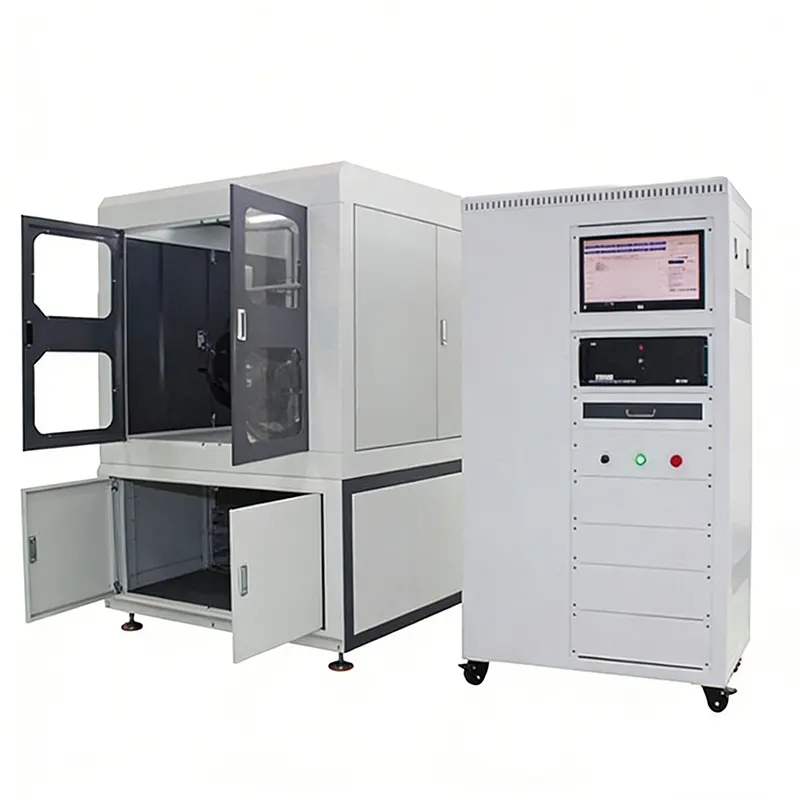
The core of this equipment is to verify the overall durability of the drive/walking system composed of wheelsets, tires, chains, chainrings, sprockets, rear axles, etc., under simulated real road load conditions.
The main subjects and purposes under investigation include:
1.Wheelset fatigue strength: To verify whether the rim, spokes, and hub will experience spoke loosening, breakage, or rim fatigue cracks under continuous rotational load.
2.Tensile strength and wear resistance of the chain: Test the wear of the chain during continuous tension and relaxation cycles, as well as whether there is any tooth skipping or jamming.
3.Transmission system meshing: Verify the long-term meshing stability between the chainring and the chain, as well as between the chain and the sprocket, and assess the wear of the tooth profile.
4.Bearing durability: Evaluate the lifespan of the front and rear axle bearings and bottom bracket bearings (if applicable) under lateral and radial loads.
5.Tire wear resistance (optional): By rolling on a simulated road surface for a long time, the wear amount of the tire tread is measured.
Test Function Description
1. Sprocket-driven travel function: A servo motor drives a large sprocket, which then drives the flywheel through a bicycle chain to rotate the wheels. The wheel set is loaded with weights vertically. The driving servo motor can control power, torque and speed. The machine roller can be loaded with damping, thereby conducting fatigue tests on the entire transmission system.
2. Pedal force test for the hub in an instant: Set the corresponding torque, and the gear motor instantly reaches the set speed to simulate the instant pedaling action during cycling acceleration. It can be used for cyclic/progressive tests:
Take the maximum torque loading point of 200 N*m as an example, where the time of the maximum torque loading point is adjustable.
Cyclic mode (both torque and time can be set):
2.1. The servo motor increases from 0 to 200 N*m (2 seconds)
2.2.The servo motor reduces from 200 to 0 N*m (within 1 second).
2.3.The torque of the servo motor increases from 0 to 200 N*m (in 2 seconds).
2.4. The servo motor decreases from 200 to 0 N*m (1 second), and at this point, one cycle is completed.
Progressive mode (torque and time can be set):
The servo motor increases from 0 N*m to 50 N*m (2 seconds)
The torque of the servo motor increases from 50 Nm to 100 Nm in 1 second.
The torque of the servo motor increases from 100 Nm to 150 Nm (in 2 seconds).
The torque of the servo motor is reduced from 150 Nm to 200 Nm in 1 second.
3. Disc Brake Rotor Braking Force Test: The wheelset is driven by a roller to rotate. Once the wheelset reaches the preset speed, the servo cylinder is activated. The cylinder stroke is precisely controlled in a closed loop with the force sensor to steadily press the brake lever, causing the wheelset to stop. During this process, the torque sensor is used to detect the braking torque in real time, accurately measuring and recording the braking force generated by the wheelset to comprehensively evaluate the performance of the braking system and the braking efficiency of the wheelset. It can be set in a constant speed and constant mileage mode.
The maximum braking speed/braking distance/braking force can be adjusted:
Constant speed and constant force braking mode: At the preset rotational speed, the electric cylinder is actuated to press the handlebar with a preset force, keeping the wheelset in a braking state and running for a specified mileage before releasing.
4. Mileage and Speed Detection: By means of the encoder installed on the roller, the running speed of the wheel set can be detected in real time and accurately. Based on the obtained speed data, the mileage of the wheel set's operation is precisely calculated through a specific algorithm.
5. Automatic shutdown upon sample damage: Equipped with sensors, it can monitor the sample status in real time. Once the sensor detects abnormal conditions such as a blown tire or deformation of the sample, the equipment will immediately activate the automatic shutdown program to prevent equipment failure caused by sample abnormalities and ensure that the test results are not affected.
6. Wheelset lateral sway: During the test, an obstacle is installed on the wheelset, which is perpendicular to the surface of the roller. The wheelset can sway left and right at a certain angle as set to simulate the effect of side-swaying while riding. The maximum sway angle can be set to 15 degrees. Through such simulation, the performance of related equipment under possible side-swaying scenarios during actual riding can be tested more comprehensively.
7. Hub wobble displacement detection: This process is completed before all tests. The firmware installs a laser displacement sensor to aim at the designated point on the side of the hub. The hub rotates three times, and the system captures the maximum and minimum values, calculates the difference to detect the wobble displacement, and determines OK/NG based on the maximum allowable value preset in the system. If it is OK, the system automatically starts the next test process; otherwise, it stops and alarms to prompt the operator.
8. Brake temperature detection: Disc brakes can experience temperature rise when in operation for a long time. By installing temperature sensors to detect the brake temperature, it can prevent brake damage caused by excessive heat.
Applicable Standards
Bicycle/Electric Bicycle Standards:
ISO 4210: Bicycles - Safety requirements (Part 7: Wheels - Test methods; Part 8: Pedals and cranks - Test methods).
GB 3565: Safety Requirements for Bicycles (Chinese National Standard, corresponding to ISO 4210).
EN 15194: European standard for electrically assisted bicycles (with higher torque requirements for the drive system of electrically assisted bicycle models).
Motorcycle standards:
ISO 8644: Motorcycles - Light alloy wheels - Test methods (including radial and lateral fatigue).