The front fork bending fatigue rearward impact testing machine is a dedicated device specifically designed to simulate the situation where the front wheel of a bicycle, electric bicycle or motorcycle ...
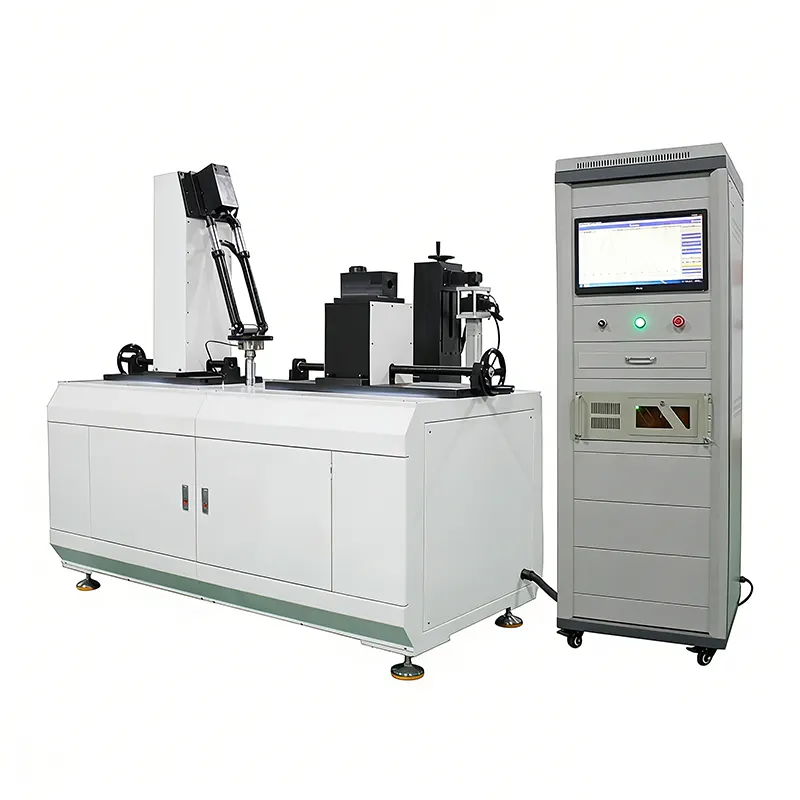
The front fork bending fatigue rearward impact testing machine is a dedicated device specifically designed to simulate the situation where the front wheel of a bicycle, electric bicycle or motorcycle suddenly hits an obstacle (such as a curb, a bump or a pothole edge) during riding, and the huge impact force is transmitted through the wheel to the front fork, causing it to bend backward and deform. This machine is used to verify the impact resistance and fatigue resistance of the front fork.
This test is one of the most stringent items in bicycle safety certification (such as ISO 4210, GB 3565), as it directly simulates the actual scenarios that can lead to dangerous situations like front fork breakage and front wheel lockup.
Technical parameters
| Parameter | Specification |
|---|---|
| Machine Max Frequency | 0–5 Hz |
| Sensor Capacity | Disc-type sensor, 5000 N × 1 unit |
| Load Cell Resolution | 1/10,000 |
| Electric Cylinder | Servo-controlled electric cylinder |
| Displacement Stroke | 150 mm (±75 mm) |
| Test Cycles | 0–999,999 (programmable) |
| Control Method (Loop) | Force closed-loop control |
| Control Mode | Computer automatic control, with displacement, force, time and other control modes |
| Control Software | Feihong proprietary software |
| Display Method | Computer control and monitor |
| Data Acquisition | High-speed acquisition card |
| Force Sampling Frequency | > 200 kHz |
| Force Waveform | Sine wave |
| Automatic Shutdown | Automatically stops when force falls below set value; automatically stops when specimen is damaged |
| Report Printing Format | Automatically saves test results for report generation |
| Frame Fatigue Fixture | 1 set |
| Weight | Approx. 160 kg |
| Power Supply | AC 220V, 15A |
| Machine Dimensions | Test bench: 1760 × 910 × 1750 mm (L×W×H) Control cabinet: 600 × 600 × 1830 mm (L×W×H) |
Applicable Standards
Bicycle Standards:
ISO 4210-6: Bicycles - Safety requirements (Part 6: Test methods for frames and forks) - Clearly stipulates the method, energy requirements and judgment criteria for the backward impact test of the fork after bending fatigue.
GB 3565: Safety Requirements for Bicycles (Chinese National Standard, corresponding to ISO 4210).
EN 15194: European standard for electrically assisted bicycles (The test requirements are similar to ISO 4210, but the overall weight of the vehicle and the additional load brought by the motor need to be taken into account, and sometimes the test energy will be higher).
Test Objective
The core purpose of this equipment is to verify the structural integrity of the front fork under simulated extreme impacts.
The main subjects and purposes of the investigation include:
Bending strength of fork blades: Verify whether the left and right fork blades undergo permanent bending deformation or fracture when subjected to a huge backward impact force.
Dropout strength: Verify whether the dropouts at the end of the front fork, which are used to secure the wheel axle, crack or deform under impact force, causing the wheel to come out.
Strength of the connection between the steerer tube and the crown: Verify whether the most critical force-bearing area of the front fork - the welded or bonded joint between the steerer tube and the crown - shows any cracks or separation under impact.
Overall structural stiffness: Measured as the permanent deformation of the front fork (bending angle or displacement) under a specific impact energy.