This machine is designed for fatigue testing of bicycle frames. It can perform horizontal fatigue tests on the head tube of bicycle frames and vertical fatigue tests on bicycle frames in accordance wi ...
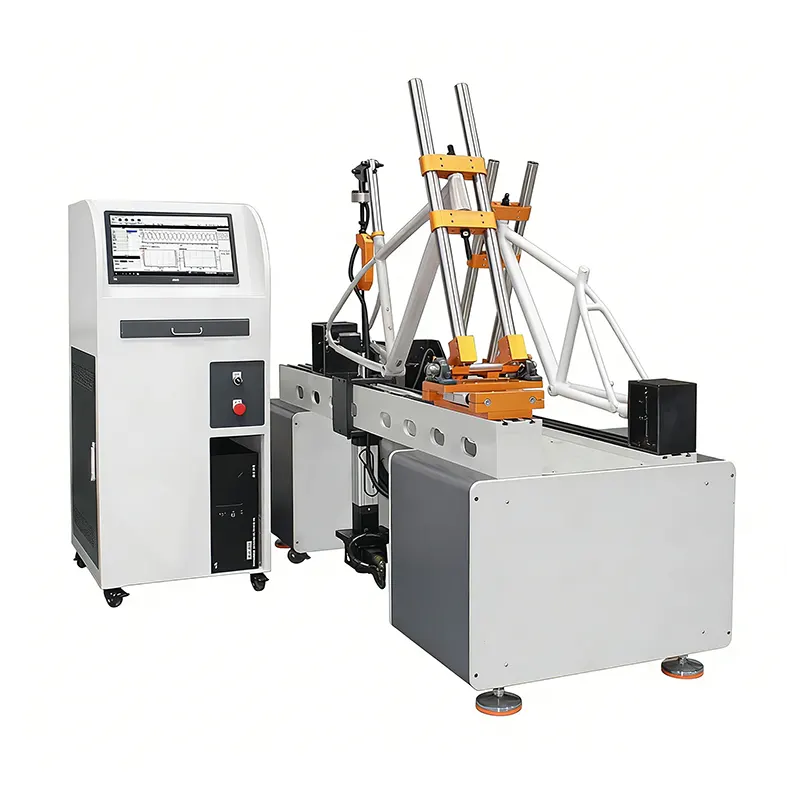
This machine is designed for fatigue testing of bicycle frames. It can perform horizontal fatigue tests on the head tube of bicycle frames and vertical fatigue tests on bicycle frames in accordance with EN 15194 for electric bicycles, (ISO4210-6.4.4) and (ISO4210-6.4.5). This test specification covers all styles of bicycle frames as per ISO4210-6.4.4.
Designed in accordance with the standards of EN 15194 for electric bicycles, ISO 4210, EN 14781 for road bikes, EN 14766 for mountain bikes, and EN 14764 for city bikes. It is also designed in accordance with the testing standards of nine countries including CNS, JIS, DIN, NF, ISO, CPSC, CSA, AS, and BS.
Technical parameters
| Parameter | Specification / Range |
|---|---|
| Machine Structure | All-steel rigid structure, adjustable spacing: approx. 300 mm, connecting plate fixed with manual screw locking |
| Servo Cylinder | 2 sets (horizontal actuation ×1 set; vertical actuation ×1 set) |
| Servo Cylinder Horizontal Actuation | Performs bidirectional tension and compression |
| Sensor Capacity | 5000 N disc-type sensor |
| Horizontal Actuation Stroke | ±75 mm |
| Vertical Actuation Stroke | ±50 mm |
| Test Frequency | 0–5 Hz |
| Displacement Sensor | Accuracy ±1%, ±0.5% calibration accuracy (static) |
| Force Closed-Loop Control (1 set fully automatic force adjustment) | Sensor dynamic control accuracy ±5% |
| Power Supply | 220V / 50Hz |
| Provided Test Fixture Set | For frame vertical and horizontal testing |
Technical highlights
1.The system is equipped with a standard database (including EN 15194, ISO 4210-6.4.4/6.4.5, etc.). After selecting the target standard, the system automatically retrieves core parameters such as "force range, frequency, and cycle count" (for example, ISO 4210-6.4.4 has a default setting of "vertical force 3000N, frequency 2Hz, 1 million cycles").
2.Supports multiple load waveforms such as "sine wave", "square wave", and "random wave" (customizable), accurately simulating various road conditions like "single impact" and "continuous jolting";
Test cycle count ≥ 1 million times (meeting the ISO standard requirement of "no cracks after 1 million cycles"), verifying the fatigue resistance of vehicle frame welding points and tubing (traditional equipment only tests 500,000 cycles, missing potential cracks).
3.Supports multiple load waveforms such as "sine wave", "square wave", and "random wave" (customizable), accurately simulating various road conditions like "single impact" and "continuous jolting";
The test cycle count is ≥ 1 million times (meeting the ISO standard requirement of "no cracks after 1 million cycles"), verifying the fatigue resistance of vehicle frame welding points and tubing (traditional equipment only tests 500,000 cycles, missing potential cracks).
4.Crack warning: When the strain gauge detects a "single cycle strain increment > 0.01mm" (such as micro-cracks at the welding point), the system automatically stops within 0.5 seconds and marks the "crack location" (accurate to ±2mm).
5.Overload protection: When the force value exceeds the set threshold (such as 110% of the target force), the actuator unloads within 0.1 seconds to prevent frame breakage or equipment damage (traditional equipment has no protection mechanism, with a test loss rate > 5%).
6.Supports PDF/Excel/CSV report export (including key parameter statistics, curve screenshots, and compliance conclusions);
Optional LIMS system interface can be configured to achieve real-time synchronization of test data with enterprise R&D/production line systems (e.g., synchronizing "cracks in a certain batch of frames after 500,000 cycles" to the quality control end to trigger batch re-inspection).
Testing differences for various frame materials
1. Metal frames (steel, aluminum alloy, titanium alloy)
Testing focus: Fatigue cracking in the heat-affected zone of welds.
Failure criterion: Generally, the appearance of visible cracks (usually detected by dye penetrant inspection or visual inspection) or a certain percentage (such as 20%) drop in load is taken as the failure standard.
Test characteristics: Metal frames typically have a more distinct fatigue life period and are suitable for high-cycle fatigue tests (such as 100,000 cycles).
2. Carbon fiber composite frame
Test focus: Interlaminar delamination, resin cracking, sudden fracture.
Failure criterion: Carbon fiber bicycle frames often fail without obvious precursors. Therefore, the stiffness changes should be monitored throughout the test. If the frame stiffness decreases (such as the slope of the load-displacement curve changes by more than 10%), it should be judged as a failure even if no cracks are observed.