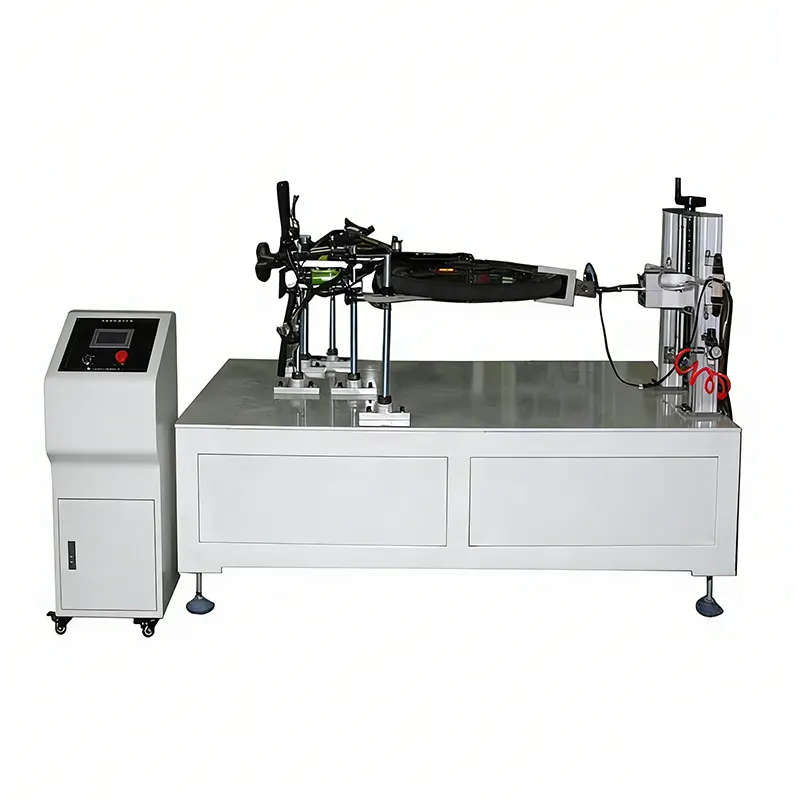
The wheel clamping force release testing machine is a specialized device designed to simulate the huge axial and radial impact forces generated during the riding of bicycles, electric bicycles and mot ...
The wheel clamping force release testing machine is a specialized device designed to simulate the huge axial and radial impact forces generated during the riding of bicycles, electric bicycles and motorcycles due to road bumps, sudden braking or high-speed cornering, and to conduct dynamic tests on the locking reliability and anti-loosening ability of wheel fastening devices (such as quick-release rods, nuts, bolts).
Technical parameters
| Parameter | Specification |
|---|---|
| Load Cell Capacity | 500 kgf |
| Timer | 0–60 s adjustable |
| Time Accuracy | ±0.1 s |
| Loading Method | Motorized loading |
| Control System | PLC + Touch Screen HMI control |
| Overall Dimensions (Main Unit) | 2000 × 850 × 2000 mm (W×D×H) |
| Weight | Approx. 160 kg |
| Power Supply | AC 220V, 15 A |
Test Objective
The core purpose of this equipment is to verify the reliability of the fastening system at the connection point between the wheel and the frame/fork under dynamic loads.
The main subjects and purposes under investigation include:
1.Fastener anti-loosening performance: Verify whether the cam pressure of the quick-release rod and the locking torque of the nut decay under continuous vibration, resulting in insufficient clamping force.
2.Dropout strength: Verify whether the dropout of the frame/fork undergoes permanent deformation or cracking when subjected to repeated pushing and pulling by the wheel.
3.Axle and hook claw fit: Verify whether the anti-rotation positioning plane (stop rotation plane) of the wheel axle (especially the hub motor shaft) fits tightly with the hook claw slot, and whether it will rotate under a strong impact (causing wire breakage or nut loosening).
4.Quick-release mechanism durability: Simulate the repeated opening and closing lifespan of the quick-release lever and the ability to maintain the locking force.
Applicable Standards
Bicycle/Electric Bicycle Standards:
ISO 4210-7: Bicycles - Safety requirements (Part 7: Wheels - Test methods) - It includes dynamic test methods for wheel fasteners, simulating the holding force of the wheel when subjected to lateral impact.
GB 3565: Safety Requirements for Bicycles (Chinese National Standard, corresponding to ISO 4210).
EN 15194: European standard for electrically assisted bicycles (with equally strict requirements for wheel fasteners, especially for hub motor models).